
What is cumulated activity and why does it matter?
Cumulated activity is the total number of radioactive decays that occur in a source organ over time. It represents the integrated activity within that organ from the moment of administration until the radionuclide is completely eliminated or decayed.
Cumulated activity is the total number of radioactive decays occurring in an organ over time and determines the magnitude of absorbed dose.
Cumulated activity is central to internal dosimetry because radiation dose depends not just on how much activity is present at one moment, but on how long it remains in the tissue.
In the MIRD schema, absorbed dose is proportional to cumulated activity.
Understanding the physics
When a radiopharmaceutical is administered, activity within an organ changes over time. It typically rises as the tracer distributes and accumulates, then falls as radioactive decay and biological clearance reduce activity.
At any given moment, the activity (in MBq) tells us how many decays are occurring per second. However, radiation dose depends on the total number of decays over time.
Cumulated activity is therefore calculated by integrating activity with respect to time:
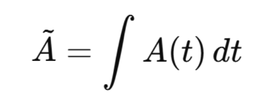
Graphically, it corresponds to the area under the time–activity curve.
Several factors influence cumulated activity:
Administered activity
Organ uptake fraction
If biological clearance is rapid, the time–activity curve falls quickly and cumulated activity is reduced. If clearance is slow, the area under the curve increases and dose rises.
This explains why effective half-life is so important: the longer activity persists in tissue, the greater the total number of decays and the higher the absorbed dose.
Cumulated activity has units of MBq·hours or disintegrations. It represents the total radioactive burden experienced by the organ.
In the MIRD equation:
Dtarget = Ãsource ⋅ Ssource→target
Cumulated activity describes how much radioactive transformation occurs; the S value describes how much energy each transformation deposits.
Where this matters clinically
Cumulated activity determines organ dose in both diagnostic and therapeutic nuclear medicine.
In diagnostic imaging, cumulated activity is relatively low because administered activities are modest and biological clearance is often rapid.
In radionuclide therapy, high administered activities and prolonged retention increase cumulated activity significantly, leading to higher absorbed doses.
Renal impairment, altered biodistribution, or tumour retention can all increase cumulated activity and therefore organ dose.