The ratio of neutrons to protons (the N/Z ratio) is critical. In light nuclei, stability typically occurs when the number of neutrons and protons is similar. As atomic number increases, additional neutrons are required to offset the increasing electrostatic repulsion between protons. When this balance is disrupted, the nucleus becomes unstable and undergoes radioactive decay to achieve a more stable configuration.
Stability is also influenced by nuclear structure effects, such as pairing of nucleons and so-called “magic numbers,” which correspond to particularly stable arrangements of protons or neutrons.
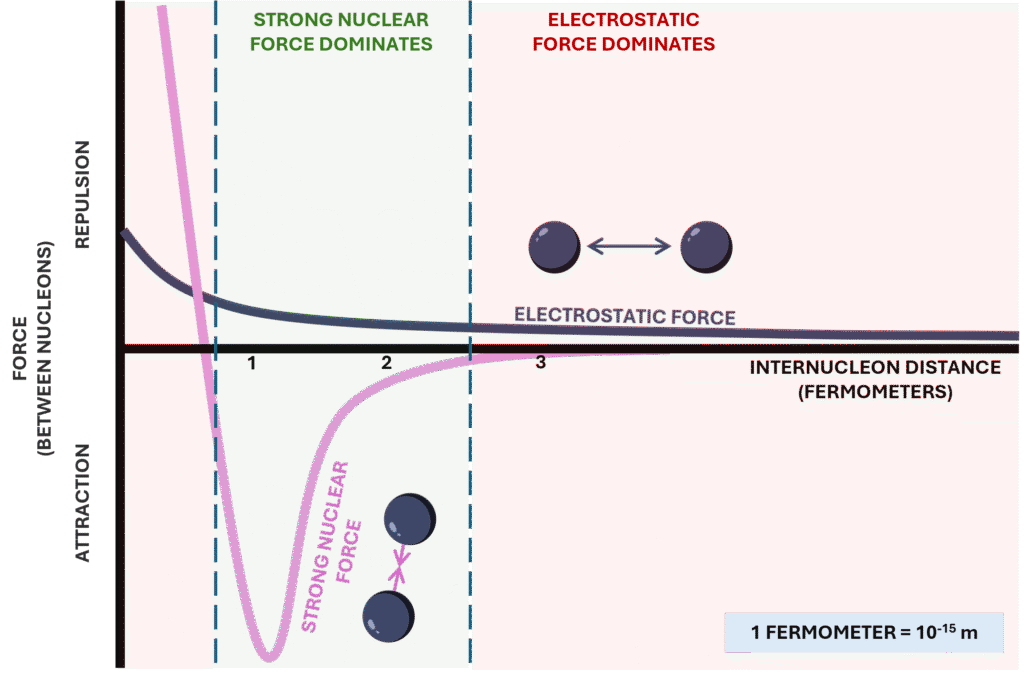
The strong nuclear force is a short-range but extremely powerful attractive force acting between nucleons (protons and neutrons). It operates over distances on the order of a few femtometres and is responsible for binding the nucleus together. Importantly, it acts equally between proton–proton, neutron–neutron, and proton–neutron pairs.
In contrast, electrostatic repulsion acts only between protons and increases as the number of protons increases. Unlike the strong force, the electrostatic force has a longer range and grows with atomic number. As nuclei become larger, the cumulative repulsive force between protons becomes significant.
Neutrons play a stabilising role because they contribute to the strong nuclear force without adding additional electrostatic repulsion. This is why heavier nuclei require a higher proportion of neutrons to remain stable. If a nucleus contains too many neutrons or too many protons relative to the stable range (often visualised as the “band of stability”), it becomes energetically favourable for it to transform via radioactive decay.
Another key determinant of stability is binding energy per nucleon, which reflects how tightly each nucleon is bound within the nucleus. Nuclei with higher binding energy per nucleon are generally more stable. Iron-56 lies near the peak of this curve and is one of the most stable nuclei known. Very heavy nuclei, however, experience such strong proton–proton repulsion that even additional neutrons cannot fully stabilise them, leading to inherent instability.
Even–even nuclei (those with even numbers of protons and neutrons) are typically more stable than odd–odd nuclei due to nucleon pairing effects. Certain “magic numbers” of protons or neutrons correspond to particularly stable nuclear configurations, analogous to closed electron shells in atomic physics.
When the balance between attractive and repulsive forces cannot be maintained, the nucleus reduces its energy through radioactive decay.
Understanding nuclear stability explains why only certain isotopes can be used in nuclear medicine. Diagnostic radionuclides must be unstable enough to emit detectable radiation, but sufficiently stable to persist long enough for imaging. Stability principles determine which isotopes exist naturally and which must be produced artificially in reactors or cyclotrons.