
What is effective dose and why is it used?
Effective dose is a calculated quantity that reflects the overall risk of stochastic effects (primarily cancer induction) from radiation exposure to the whole body. It accounts not only for the absorbed dose to individual organs, but also for their differing biological sensitivities to radiation.
Effective dose is measured in sievert (Sv) and allows comparison of radiation risk between different imaging procedures, even when the dose distribution across organs differs.
Effective dose is a risk-weighted measure of whole-body radiation exposure, expressed in sievert, used to compare stochastic risk between imaging procedures.
It is primarily used for radiation protection and population-level risk estimation, not for predicting individual patient outcomes.
Understanding the physics
Absorbed dose tells us how much energy is deposited per unit mass of tissue, measured in gray (Gy). However, not all tissues respond equally to radiation.
For example, bone marrow and breast tissue are more radiosensitive than muscle. Therefore, the same absorbed dose to different organs does not carry the same long-term risk.
Effective dose addresses this by incorporating:
The absorbed dose to each organ.
A tissue weighting factor that reflects the relative sensitivity of that organ to radiation-induced cancer.
Mathematically, effective dose is calculated by summing the weighted equivalent doses across all irradiated organs:
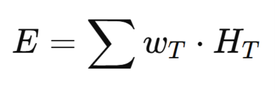
ωT is the tissue weighting factor
HT is the equivalent dose to tissue T
Equivalent dose itself adjusts absorbed dose according to the type of radiation (using radiation weighting factors). In diagnostic nuclear medicine, most exposures involve low-LET radiation, so radiation weighting factors are typically close to 1.
Effective dose therefore represents a risk-weighted whole-body dose estimate.
It is important to recognise that effective dose is a model-based quantity derived from reference populations and standardised weighting factors. It is not a directly measurable physical quantity.
Where this matters clinically
Effective dose is used to:
Compare radiation risk between different imaging modalities.
Inform justification of imaging procedures.
Communicate approximate radiation risk to patients.
Establish diagnostic reference levels.
However, effective dose should not be used to estimate organ-specific toxicity or to predict individual cancer risk precisely. It is most useful for comparing procedures and guiding radiation protection strategies.
Related questions
What is absorbed dose?
What is the difference between absorbed dose and effective dose?
What is the radiation risk from diagnostic nuclear medicine?
How is radiation dose calculated in nuclear medicine?